How Population Geography Affects Climate, Consumption and Reproductive Freedom: Insights from Dr. Helen Hazen
Reading time
Date posted
In light of World Population Day, we’ve put together a curated collection of books that revolve around the topic of population. Explore the collection here.
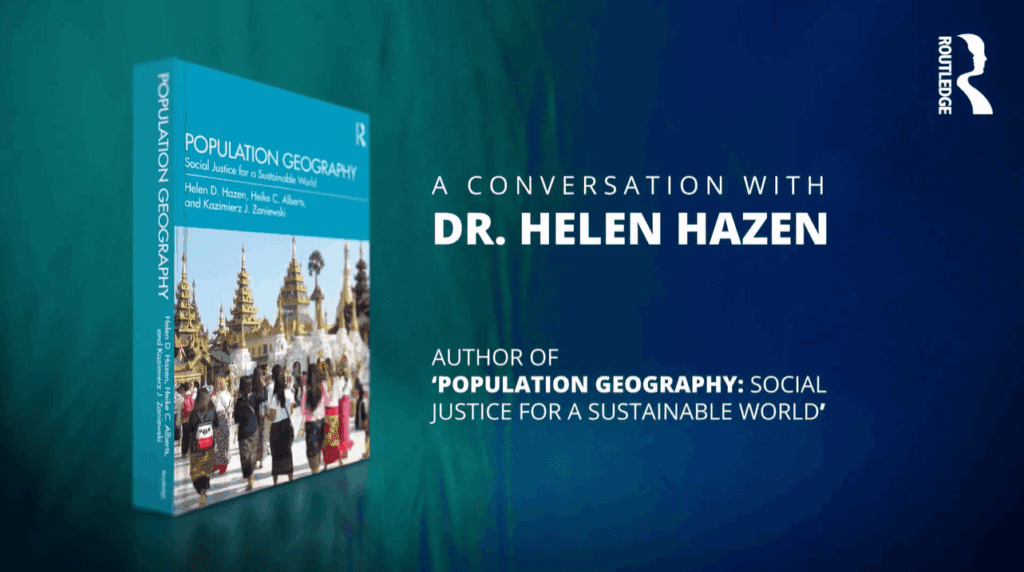
As the world navigates complex questions of population growth, decline, migration, and climate change, issues of social justice and sustainability have never felt more pressing. Dr. Helen Hazen, teaching professor at the University of Denver and author of Population Geography: Social Justice for a Sustainable World, explores these themes in her work.
We spoke with Dr. Hazen to learn how population geography offers a critical lens on global challenges, and why focusing on equity and human rights is essential for a sustainable future.
Watch the full interview:
Check out the full video interview on our YouTube channel.
Population Geography and Social Justice
Your book looks at population through the lens of social justice. How can understanding where and how people live help us address issues like unequal access to housing, healthcare, or education?
The population scale is an important level of analysis because the ways in which people organize their societies are influenced by broader structures like the global economy, political forces, new patterns of globalized connectivity, and the tensions that these broader large-scale processes have with the goals and aspirations of individuals.
This is leading to dramatic new ways in which individuals and communities interact with one another, and that has powerful implications for the ways in which people use the earth. So, this population scale of analysis is particularly significant.
To give a few specific examples: our food systems have been transformed at the global scale by globalized methods of production. On the local scale for individuals, this changes the opportunities associated with rural life. Looking at these two scales, the population scale and the individual scale, is important.
Another example would be new forms of government evolving with new international and subnational pressures. These are changing the ways in which government provides social safety nets, care for the elderly, education for our children, and so on. Population issues are at the center of many of these challenges, in particular changing demographic structures.
For example, aging populations and falling birth rates are placing new pressures on the old economic expectation that a constantly growing workforce will keep raising living standards. How we deal with that in the future is going to be really interesting. We’re going to have to work out new ways to work smarter and more efficiently with a shrinking workforce.
Meanwhile, in other places, we have continued population growth, which is straining social safety nets in the opposite direction, putting pressure on affordable housing and increasing demands for things like food and water, and services like education and healthcare. These paradoxical trends of both population growth and population decline are what make the current population moment so interesting.
On the one hand, ecologists are concerned with the pressures of a growing population straining our resource base. On the other hand, economists are closely monitoring how diminishing populations in certain regions are straining the generous welfare states that were put into place in a post-war period of rapid economic and population growth.
Population is at a really interesting inflection point. Further study of these sorts of topics is going to be really important as we work out where we go next.
Population and Environmental Challenges
Population and environment are deeply connected. How can population geography help us understand and respond to climate challenges, especially in communities that are hit hardest?
Population issues are deeply intertwined with environmental issues. The sustainability focus of the book recognizes that as a pivotal point. As biological beings, humans create waste and use resources, and there’s no getting away from that. Every additional individual on Earth has some environmental impact, that is simply an ecological reality. However, the situation gets more interesting because there’s a deep-seated controversy over the relative contribution of population size versus consumption patterns with respect to environmental impacts. Fully understanding the role of population is important for drawing useful conclusions. Is it simply that we have “too many people,” or is it more about the way that people are interacting with their environment?
Many of us have heard the comparison that an average American family of three or four is using far more resources than a rural Pakistani family of eight or nine, for example. This is really the root of the population-consumption debate. We must recognize that both population size and consumption patterns are significant. But if we want to address environmental concerns in a social justice framework, we must balance concern with population alongside concern with consumption.
If we look at climate change specifically, we can consider the importance of growing populations as well as consumption patterns. When we think about the challenges of excess carbon, it’s both growing populations and growing affluence, more meat consumption, more transportation, more heating and cooling of houses, that are driving more and more carbon release into the atmosphere.
At the top end of the spectrum, there is a small proportion of very affluent individuals who represent a very large portion of carbon release through things like air transportation. As a global community, we know that we need to reduce emissions. But if we’re going to think about climate change in a social justice framework, high per capita emission countries will have to do the lion’s share of the work if we really want to address this fairly.
The social justice framework is also important when thinking about the impacts of climate change on communities. Coastal regions are anticipating rising sea levels, those at high elevation are experiencing melting glaciers and diminishing irrigation water, communities in semi-arid regions are seeing increasingly erratic rainfall, and Arctic populations are experiencing some of the highest rates of warming. Many of the communities at greatest risk are indigenous, rural, of low socioeconomic status, and often marginalized in other ways. This represents an important intersection of differing vulnerabilities. Thinking in a population framework allows us to analyze these subpopulations and recognize that climate change doesn’t affect everybody equally.
Population Policies for a Sustainable Future
In parts of the world with fast-growing youth populations, what does a just and sustainable population policy look like? And how can we make sure it works for future generations?
We know that population growth is slowing, and in some localized situations, we are even seeing dramatic population decline. But the population story for the next 50 years is going to be one of net growth, that is really an inevitability. Given the challenges we already face with providing living spaces and resources for 8 billion people, the idea of adding another couple of billion is hard to comprehend.
Meanwhile, we also hope to pull more people out of poverty, many of whom are living in the same countries experiencing the fastest growth. How do we provide additional resources and opportunities for people in the poorest parts of the world, which are also experiencing rapid population growth?
In the past, we used draconian population policies in many countries that limited people’s reproductive freedoms. But we have learned that the social justice challenges associated with those programs are often too high to bear. In fact, giving people reproductive freedom seems to slow population growth significantly. Some of the countries that have seen impressive declines in population growth did not use restrictive policies but instead provided increased reproductive opportunity.
Women in particular typically choose to have fewer children when they have the opportunity to do so, and when they believe those children will survive and have access to education and rising living standards. We don’t need to force people to have fewer children to slow population growth. That is the amazing win-win that has happened as a side effect of modernization and development processes.
What would a fair and just population policy look like for fast-growing youth populations? I would suggest it is one of reproductive education and autonomy, not strict restrictions on population growth. It means easy access to a range of effective family planning options, as well as equitable social support programs that enable new generations to seek out education, healthcare, and affordable housing at reasonable cost.
Another aspect is that we have rapidly diminishing populations in some places and still growing populations in others. This suggests we need to pay a lot of attention to migration policy. Fair migration policies that allow for international mobility would be beneficial to both sides, both growing and diminishing populations. Instead of locking the world down, allowing fast-growing young populations to join the workforce in rapidly aging regions makes economic and social justice sense.
This will be an important issue to watch into the future, especially as our current political scene seems to be moving in the opposite direction.
Learn more

Population Geography: Social Justice for a Sustainable World
Population Geography: Social Justice for a Sustainable World surveys the ways in which geographic approaches may be applied to population issues, exploring how human populations are embedded in natural and social environments.