Being Black and British: In Conversation with Dermot Daly
Reading time
Date posted
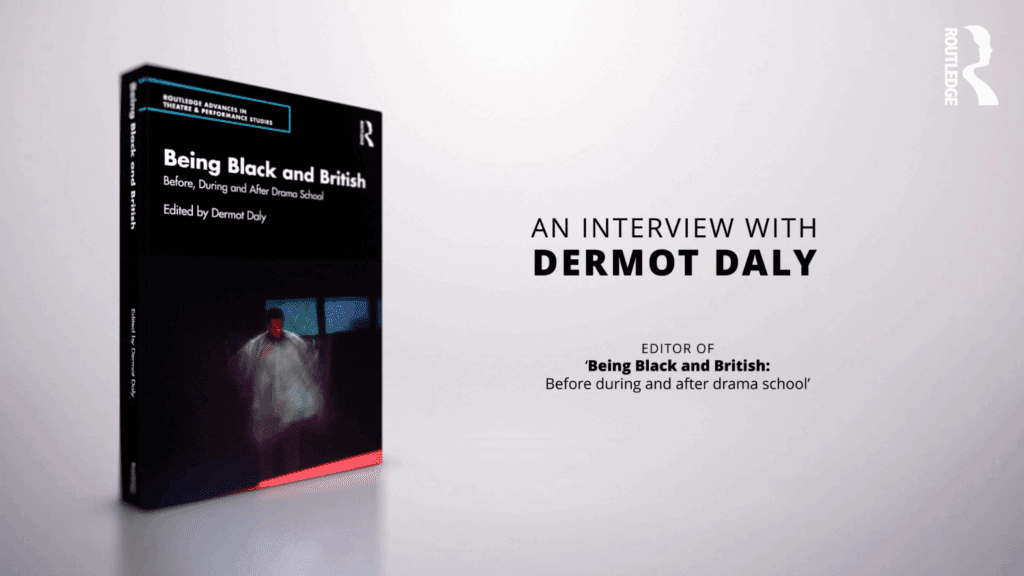
The editor of Being Black and British: Before, During and After Drama School discusses representation, canonical reform, and creating opportunities for the next generation of Black British performers.
Dermot Daly is a senior lecturer at Leeds Conservatoire and Leeds Beckett, an academic, researcher, and theatre maker whose journey began at age 10 when he joined a youth theatre and “never really left.” His latest project, editing a groundbreaking collection on Black British actor training, challenges institutions to reimagine how they prepare performers for professional life.
Watch the interview
This blog post features a few key extracts from our conversation with Dermot. If you’re interested in viewing an extended version of the interview, check it out on our YouTube channel.
Who are you hoping to reach with this book?
I’m hoping to reach anybody who is interested in performance. I’m hoping primarily to reach the 15-year-old version of me, who is somewhere in the country, somewhere in the world maybe, but somewhere in Britain, who doesn’t know where to go, who doesn’t know what they’re capable of, who doesn’t necessarily have all of the opportunities that other people might have.
It’s for the teachers of those students, those young people, it’s for the parents and the carers of those young people, and I keep saying young people, hopefully there’s something in the book for everyone.
Why is there a scarcity of Black British drama trainers?
The scarcity of Black British drama trainers is a pipeline issue. If you look at drama schools now, what you’re actually looking at is the industry in 10 years. So if you look at those people who are teaching, what you’re looking at is people who were in drama school 10, 15, 20, 30 years ago. So the scarcity is essentially just seeing that pipeline, or lack of pipeline, filter to where we are.
I think sometimes what is privileged, especially in drama schools and especially in higher education more broadly, is the ability to have ‘the right bits of paper’. That scarcity is partly because of the pipeline and partly because of the opportunities and the machinations of getting to that point, not always being fully available.
I think it’s also a lack of imagination on the parts of people who are hiring and building training teams not looking beyond academia.
Would reshaping the dramatic canon help in any way?
Yeah, I think the canon of work that we work on is something that’s received and this idea of ‘received wisdom’. I want to question that idea. Received from who and for what reason?
This kind of diversification of the canon, and adding more, is not a zero-sum game. I am not for one minute advocating that we remove Shakespeare, but I am advocating that if we’re teaching Shakespeare, then we need to find somebody else. I would suggest that if we are looking at Caryl Churchill, who is an incredible writer, that we also look at Debbie Tucker Green, who is an incredible writer. But you will more often find Caryl Churchill in a drama school canon than you will Debbie Tucker Green.
I think in the book I talk about how if all we ever had was Shakespeare, then if you weren’t a white male writer, then you wouldn’t see yourself as a writer. And I think that is such a big problem. There is a huge thing around representation . . . seeing yourself represented and seeing your thoughts and your feelings and who you are and where you come from and the people that you hang out with.
Ryan Cameron in the book talks about the richness of Black stories . . . but the richness of those Black stories that he was seeing every day, but wasn’t seeing in drama school.
In the canon chapter, what I argue for is looking at the room in front of you, especially if you’re in drama school, and seeing who is in that room, and then looking at what you’re working on and seeing how those two things align or not.
The work that we study and the curriculum that we work around, as I said, is not a zero-sum game. It’s not about having a different cake. It’s about slicing it slightly differently.
This book focuses primarily on theatre. Do you believe theatre provides the best foundation for actors across all performance mediums?
I’d be wary of saying it’s the best because I think there are lots of different ways, lots of different routes in. However, theatre is ephemeral, which is beautiful. We can go and see a show tonight, and we can see exactly the same show tomorrow, but we won’t, because today it was sunny and tomorrow it’s raining. Today I’m awake, tomorrow I’m really tired. Tomorrow the understudy’s on, but not on the performance that we see tonight.
So I think that ephemeral nature of theatre is really useful because that’s what life is, right? You don’t get a second chance at life in the same way that you don’t necessarily get a second chance at doing a scene. If it goes wrong, it goes wrong. Let’s work out what happens next.
I think there’s something uniquely British about theatre training. And this book is situated around being Black and British . . . and one of the things that is very uniquely British is theatre.
The tension between that and the Black American experience, which is more so screen than it is theatre, marks a difference.
I think theatre actors often move into film and often move into audio. If you have a solid grounding in thinking on your feet, if you have a solid grounding in projection, if you have a solid grounding in character arc, if you have a solid grounding in stories and thematic structure, that will carry across any medium.
I think offering is what needs to be done, as opposed to gatekeeping.
How do you feel Black History Month in the UK differs from its American counterpart?
The biggest, most obvious difference between Black History Month in the US and Black History Month in the UK is that we get more days. I have a really troubled relationship with Black History Month as a concept . . . I don’t need one day a year to celebrate all of the women in my life. I do not need a month to celebrate Pride. I don’t need a Black History Month because it’s all the same. We are humans.
That said, I think Black History Month and these celebration days are really important . . . My issue comes with that, on November the 1st, are we still going to be talking about Black history? The other issue is, what is Black history? Black history is human history, just with a different colour skin.
The reason why Black History Month in the UK annoys me is that we’ll talk about Rosa Parks, and people will know who Rosa Parks is, but people won’t know who Paul Stevenson is, and that really troubles me. Both of whom started bus boycotts, both of whom challenged the hegemony, both of whom won, essentially.
But we look to the US because if we look to the UK, it becomes a little bit too close. It means that we have to think, we have to be more introspective. Whereas looking over there, we can celebrate all of that because that’s over there. That’s not us.
What are your hopes for the book?
I think it needs to start a conversation. It needs to keep that conversation going. What I’m really looking forward to is people disagreeing with me, and I’m really looking forward to the joy in those conversations and the alchemy in those conversations.
I hope it allows people to have difficult conversations . . . let’s not be throwing sticks and stones at each other, please, but let’s have a civilised conversation about what is here and why it is here, and then work out where we go.
I did not want this book to be a pity party, and I don’t think it should be. This book is not about trauma, although trauma is in there because we’re humans and all humans suffer trauma. But this book is about hope. This book is about fortitude. This book is about saying, look, you can do it.
This is the book that I wanted and I needed when I was 15, to hold a book that has 22 authors who are Black and British, talking about what it means to be Black and British in theatre, in the performance industries in this country, some of whom have won Oliviers, some of whom have had West End shows, and some of whom have worked internationally.
We’re talking about the richness that this country can offer. We’re talking about the richness that is already here, that is being overlooked. We’re talking about the richness that might never be cultivated because some people, some Black British people, might not see a way through.
Ultimately, this book needs to be out of print in 50 years because everything in it should be pointless. We shouldn’t be talking about it, it should just be the thing that is done.

Being Black and British: Before, During and After Drama School
Written by Black industry professionals, Being Black and British: Before, During and After Drama School serves as a valuable guide traces the journey of many Black British actors through their careers whilst also providing a call to action for those who train and work with Black performers.
Being Black and British: Before, During and After Drama School is published by Routledge. For more information about the book and its contributors, click here.