A New Math Game (with Free Download) from ‘Well Played, Grades K-2’
Reading time
Date posted

Games and puzzles are a favorite part of math class for many students and teachers. But how can we create game-playing experiences that are mathematically meaningful as well as engaging and collaborative? In the second edition of Well-Played, Grades K-2, authors Linda Dacey, Karen Gartland, and Jayne Bamford Lynch answer that question and introduce us to a collection of new and updated math games.
Each math game and puzzle in the book includes:
A short explanation of the mathematical ideas the game or puzzle supports.
Variations for each game or puzzle to address a range of learning levels.
Classroom vignettes and tips that model how to introduce the featured game or puzzle.
Exit card choices and student work examples that make real-time assessment a meaningful part of teaching with games and puzzles.
All the materials you need, ready to photocopy and get started!.
Let’s take a sneak peek at From Here to There, one of the 25 games and puzzles included in Well-Played, Grades K-2.
And if you’re looking for a math game for older students, check out The Between Game from Well Played, Grades 3-5.
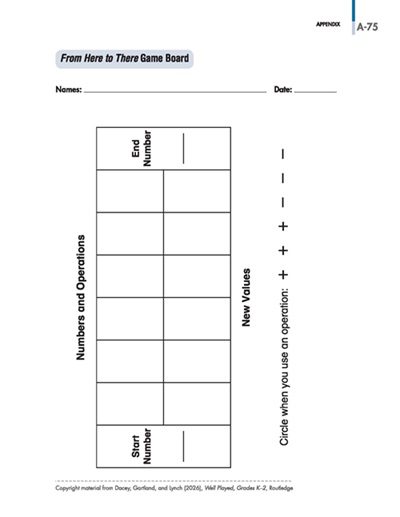
From Here to There
Why This Game
In this game, one player identifies the start number and the other player identifies the end number. Their task is to make exactly six “moves” to get from the start to the end number. A move involves choosing a number
and either addition or subtraction. Then, beginning with the original start number, apply those choices to find a new value. Players must also meet the requirement to use each of the two operations three times within those six moves. As the players share the same goal, there is an incentive to cooperate by discussing and reflecting on their possible choices.
Repeated play gives students the opportunity to recognize that applying the inverse of an operation allows them to undo a previous move, a strategy that would be particularly helpful if they reach their goal before completing six moves. Recognizing inverse relationships will help students be successful in higher-level mathematics.
Math Focus
Computing sums and differences.
Recognizing inverse relationships.
Variations
Have players play in teams so they can compute together.
Require each player to use each operation at least once.
Once students recognize the usefulness of inverse operations, you could add the rule that students can only use a number once within the game.
Have students create game boards with different numbers of moves. For example, a board with eight moves could require using each operation four times.
Require the start and end numbers to be a determined number of digits.
Exit Card Choices
If you had a start number of 5 (or 20), how might you get to an end number of 10 (or 50) in two moves, one involving addition and the other, subtraction?
What strategies did you develop to improve your play?
How did you decide when to add or subtract?

Well Played, Grades K-2: Building Mathematical Thinking Through Number Games and Puzzles
Now in its second edition, Well Played, Grades K–2 offers twenty-five engaging games and puzzles which have all been field-tested in diverse classrooms, and new full-sized appendices of all game boards, puzzles and other materials make preparing for play an easier than ever.