Middle Schoolers Love Math Games and Puzzles Too! Download a Free Math Puzzle
Reading time
Date posted

Math games and puzzles aren’t just for elementary school–they’re a great way of engaging middle school learners in mathematically meaningful and collaborative experiences. In the second edition of Well-Played, Grades 6-8, authorsLinda Dacey, Karen Gartland, and Jayne Bamford Lynch introduce us to a collection of new and updated number and algebraic games and puzzles that build math thinking.
Each math game and puzzle in the book includes:
A short explanation of the mathematical ideas the game or puzzle supports
Variations for each game or puzzle to address a range of learning levels
Classroom vignettes and tips that model how to introduce the featured game or puzzle
Exit card choices and student work examples that make real-time assessment a meaningful part of teaching with games and puzzles
All the materials you need, ready to photocopy and get started!
Let’s take a sneak peek at Find One, one of the 25 games and puzzles included in Well Played, Grades 6-8.
And if you’re looking for math games and puzzles for younger students check out The Between Game from Well Played, Grade 3-5 and From Here to There from Well Played, Grades K-2.
Find One
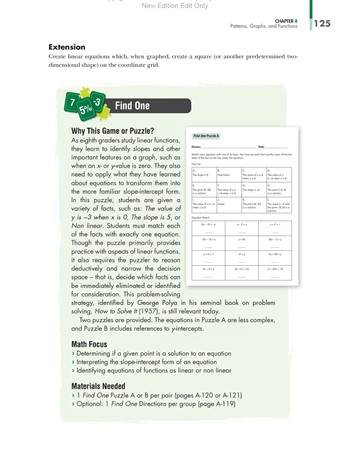
Why This Puzzle
As eighth graders study linear functions, they learn to identify slopes and other important features on a graph, such as when an x – or y -value is zero. They also need to apply what they have learned about equations to transform them into the more familiar slope-intercept form. In this puzzle, students are given a variety of facts, such as: The value of y is −3 when x is 0, The slope is 5, or Non-linear. Students must match each of the facts with exactly one equation.
Though the puzzle primarily provides practice with aspects of linear functions, it also requires the puzzler to reason deductively and narrow the decision space – that is, decide which facts can be immediately eliminated or identified for consideration. Two puzzles are provided. The equations in Puzzle A are less complex, and Puzzle B includes references to y-intercepts.
Math Focus:
Determining if a given point is a solution to an equation
Interpreting the slope-intercept form of an equation
Identifying equations of functions as linear or non linear
Variations:
This puzzle could also be a game. Cut apart the facts to use as cards. To play the game, students deal all the cards, and on each turn, a team places a fact on one of the equations on the shared equation board. Only one card may be placed on each equation. Teams alternate turns. The game ends when a player cannot place a card. The team with the fewest cards left in its hand wins.
You can replace the y-intercept language in Puzzle B with The value of y is… when x is 0. Or, you could incorporate the x-intercept to replace facts that read The value of x is… when y is 0.
Exit Card Choices:
Create a set of two coordinate points that could be used to make a line with a slope of 4.
Explain your reasoning.Which clue was the most helpful to you in the beginning? Why? Which clue was the least
helpful to you in the beginning? Why?
Related book
Well Played, Grades 6-8
Building Mathematical Thinking Through Number and Algebraic Games and Puzzles
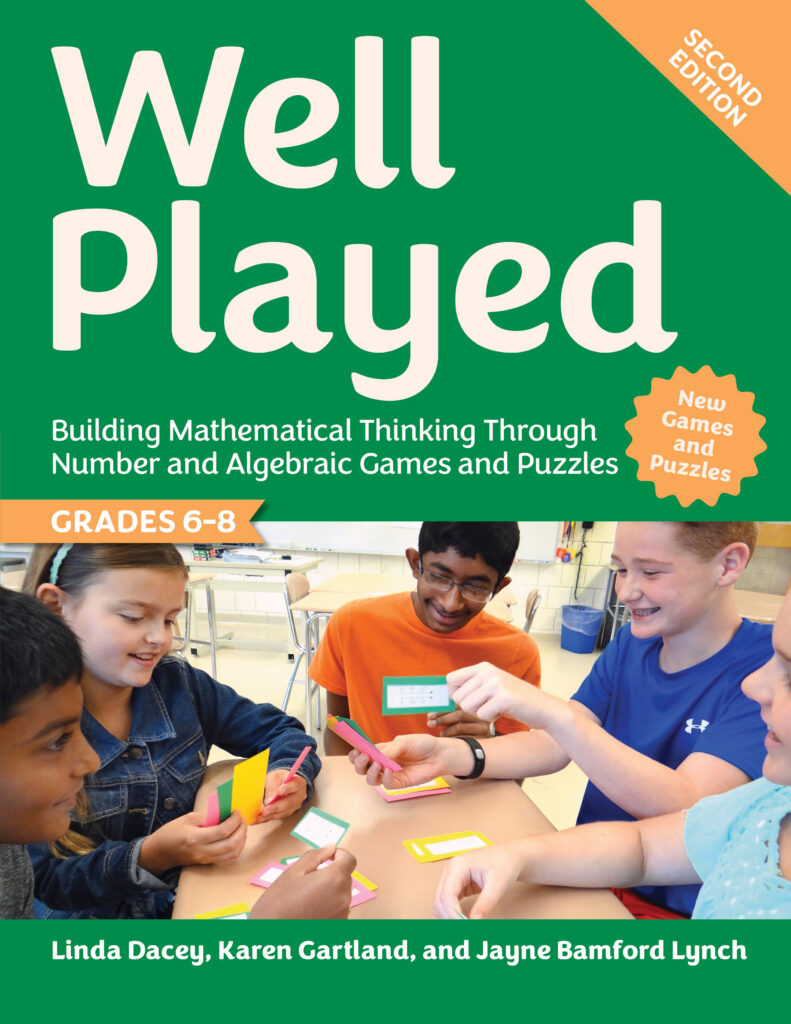
Students love math games and puzzles, but how much are they really learning from the experience? Too often, math games are thought of as just a fun activity or enrichment opportunity.
Well Played, Grades 6–8: Building Mathematical Thinking Through Number and Algebraic Games and Puzzles shows you how to make games and puzzles an integral and engaging part of the math classroom.
