Television Studies in Queer Times: A Conversation with F. Hollis Griffin
Reading time
Date posted
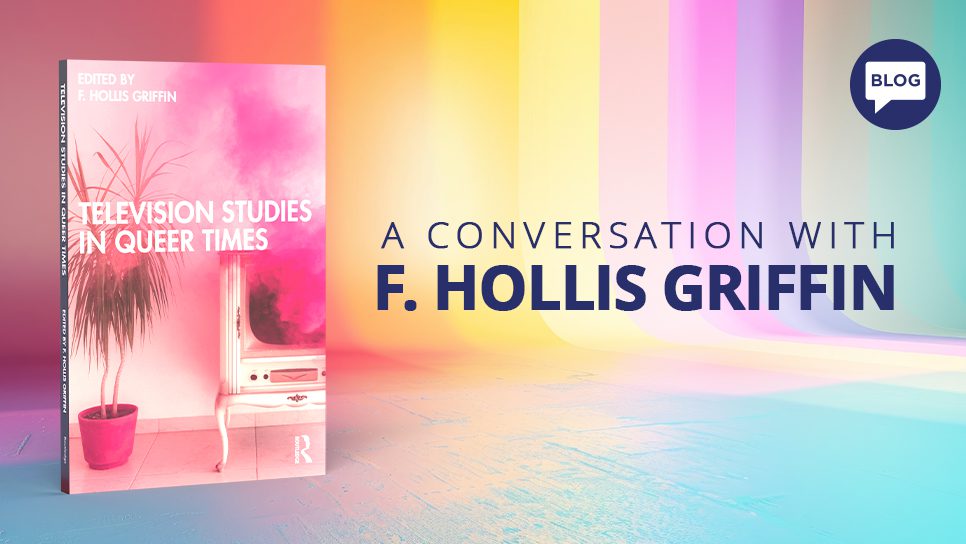
In an era when streaming platforms have revolutionized how we consume media and LGBTQ+ representation has gained further mainstream visibility, the relationship between television and queer identity remains complex and nuanced. Recently, we had the privilege of speaking with F. Hollis Griffin, editor of Television Studies in Queer Times, about his groundbreaking work examining the intersection of sexuality and television in contemporary media landscapes.
Understanding “Queer Times”
When asked about the concept of “Queer Times,” Griffin explained that the term isn’t meant to define a specific historical era but rather describes our current context — one where sexual minorities are central to television production and distribution in unprecedented ways, even as LGBTQ+ rights come under greater threat globally.
“I wanted to think about a moment when television was central to all kinds of conversations going on in all kinds of different places about the rights of sexual minorities, about the cultures, bodies, desires of sexual minorities,” Griffin explained. “It’s less about a specific historical moment than it is about thinking about the weird topsy-turvy climate in which conversations about sexual minorities are central… even as there are reinvigorated attempts to clamp down on them.”
Beyond Visibility
Griffin cautions against equating increased visibility with progress or equality. He pushes back against the notion that LGBTQ+ representation has simply “increased” over time, noting that “there have been queer images and queer narratives on television since its inception.”
What has changed, according to Griffin, is how the industry perceives and targets LGBTQ+ audiences:
“What is different, I think, is the extent to which queer audiences are imagined throughout the cycle of production and distribution and are imagined as consumer demographics in new ways…as LGBTQ youth are imagined as distinct consumer demographics and they are figured into programming decisions at the level of industry.”
Groundbreaking Representation: Looking Beyond the “Firsts”
When discussing groundbreaking LGBTQ+ representation on television, Griffin looks beyond industry-celebrated “firsts” to examine programs that made non-conformity central to their narratives. He points to “The Facts of Life” as a surprisingly significant example:
“I think a show that I always point to as being interesting… is the show Facts of Life, which had a character come in in the second season, Jo, who was a tomboy and had a huge lesbian fan following. And I understood her as queer as a kid when I was watching.”
Griffin explains that Jo’s character, along with her “frenemy” Blair, formed what many viewers read as a butch-femme pairing, with their class and gender struggles central to the program. Despite neither character being explicitly “out,” the show’s longevity and the centrality of gender non-conformity made it groundbreaking.
He also highlights examples from earlier decades: “There’s also a bunch of shows from the 50s and 60s that had Butch women as supporting characters,” and points to Paul Lynde on “Hollywood Squares” as “a queen” who became “a mainstay in a television game show.”
These examples, Griffin argues, were groundbreaking because “they snuck in unbeknownst to people. But the people who knew, knew.”
The Shift from Desire to Identity
Griffin observes a significant shift in contemporary LGBTQ+ content, away from questions of desire and embodiment toward questions of identity:
“While there’s no question that there is an increase in quantity of content that takes up these issues, there is not a neat relationship between that increase in quantity and the increase in quality.”
He points to Netflix’s “Heartstopper” as an example of programming that focuses more on identity than desire: “It is less about questions of desire than it is about questions of identity… it is more about coming out to family and coming out to peers and feeling accepted.” This shift, Griffin suggests, has political implications: “When we imagine that increase in quantity as having a linear relationship to political discourse, that’s dangerous because that’s not what’s happening.”
Creating a New Critical Framework
Griffin’s approach to organizing Television Studies in Queer Times was deliberate and innovative. Rather than using traditional frameworks, he sought to develop “a new critical vocabulary that thought about television as the kind of complicated object it is.”
After collecting essays from contributors, Griffin literally spread them across his office floor to identify emerging themes:
“I printed them out and I moved them around the office floor, and I thought about the things that spoke to one another. And I thought about the themes and terms that emerged from putting them in conversation with one another.”
From this process, several key themes emerged:
Historicity: How representations are contextualized in their original circulation
Plays with Time: How LGBTQ television content manipulates, reimagines, or corrects historical narratives
Ideological Contradiction: The complex and sometimes contradictory politics within representations
Industry Labor: The various professionals and contexts that produce LGBTQ television
Television’s Future and Reaching Younger Audiences
Looking forward, Griffin expresses concern about television’s relevance to younger generations. He notes that his students aren’t engaging with television in traditional ways:
“My students aren’t watching television, don’t talk about or think about television… They’re not looking to television for questions about sexuality. They’re looking to user-generated content on social media platforms.”
Griffin hopes for greater synergy between television and platforms like TikTok, not just superficial “social television” initiatives, but genuine integration that speaks to how younger people actually consume content:
“I’m hopeful that television as a conceptual category finds a way of energizing young viewers in new ways because I think that there’s something about television that is not speaking to them right now.”
The Lasting Impact of Television Studies
Despite these challenges, Griffin remains convinced of television’s importance as a cultural object. He hopes readers of his book will leave with “a reinvigorated sense that television still matters, and that television is still an object that reveals a lot about the ways that people live and the ways that people desire and the ways that people understand themselves in relation to a larger orbit of sexual desires and sexual identities.”
By providing new conceptual frameworks for approaching television and sexuality, Griffin aims to open avenues for engaging conversations about the relationship between media representation and LGBTQ+ politics — conversations that will continue to evolve as television itself transforms in the digital age.
As we navigate this complex media landscape, his work encourages us to look beyond surface-level visibility to examine the deeper cultural, political, and industrial forces that shape how LGBTQ+ stories are told…and who gets to tell them.

Television Studies in Queer Times
This timely collection of essays interrogate queer television at the start of the twenty-first century. The complex political, cultural, and economic milieu requires new terms and conceptual frameworks to study television and media through a queer lens. Gathering a range of well-known scholars, the book takes on the relationship between sexual identity, desire, and television, breaking new ground in a context where existing critical vocabularies and research paradigms used to study television no longer hold sway in the ways they used to.