Productive Struggle in the K-12 Classroom
Reading time
Date posted

Productive struggle is a hot topic, whether we’re discussing if students should use AI to avoid struggle, or analyzing professional athletes who share the value of struggle. The real question is: what is productive struggle and what does it look like in the classroom?
Defining Productive Struggle
Let’s start with defining productive struggle. Our definition focuses on pushing through when you don’t know something so that you can adapt what you know to something new.
Productive struggle is an opportunity for students to participate in a structured instructional situation in which they adapt current knowledge to solve a novel problem.
There are several key words and phrases. First is student participation. You simply can’t have productive struggle without students participating in the process. A common myth is that when students give up, you made the task too hard. That’s not necessarily true. I would ask if you provided the support tools students can use so they can push through. Did you give students opportunities to put forth effort in a safe way so they learn the skill of perseverance? Those are critical aspects of productive struggle.
Notice it is a structured instructional situation. Generally, teachers plan and craft the opportunity for students to apply prior knowledge in a new situation at a level which requires the right level of struggle—not too little, not too much. Teachers can use a skills guide to assist them in choosing appropriately challenging work.
Developing vs. Appropriately Challenging Work for Productive Struggle
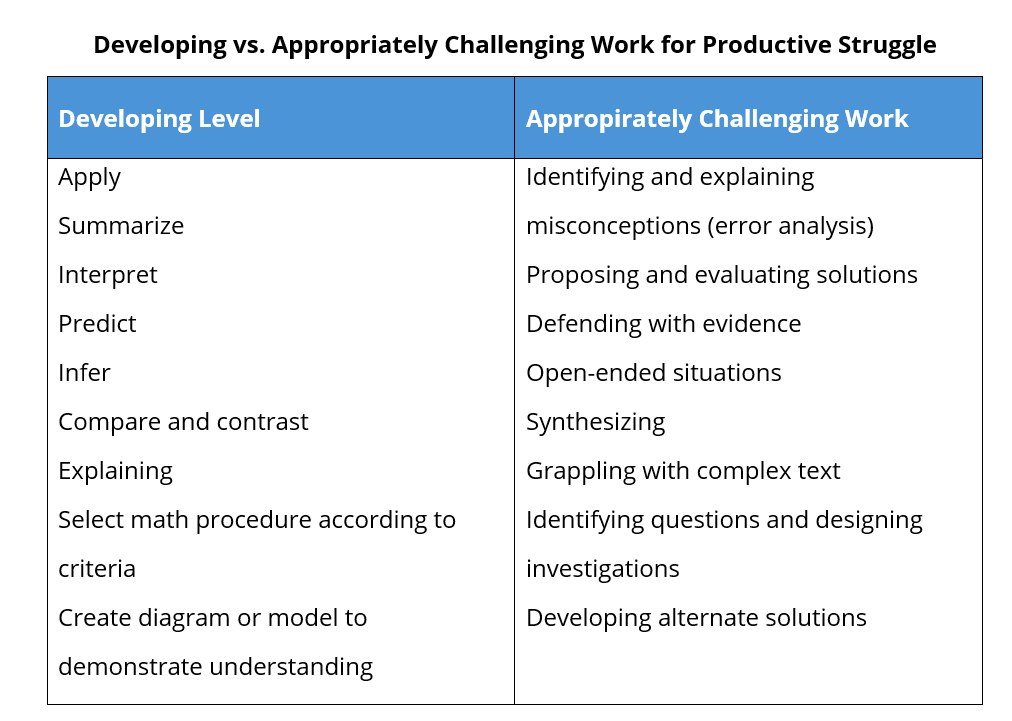
The chart provides a guide to learning skills for productive struggle. However, there are also five key learning dispositions that lead to success in productive struggle. Let’s look at what they look like in a productive struggle classroom. Ideally, students would work at a proficient level, but they may need to move through the other levels as they learn to be successful.
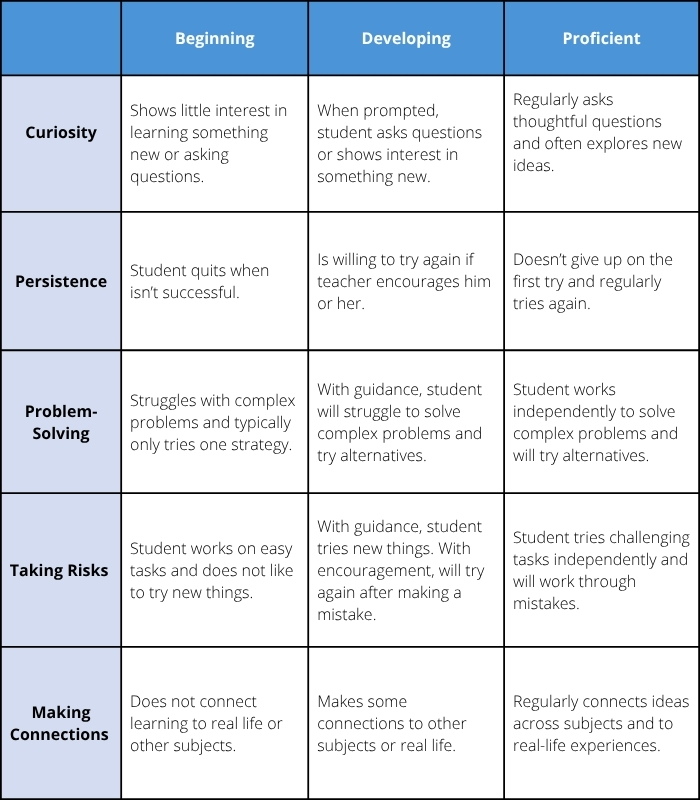
Productive struggle allows our students to push through a challenging situation and learn to overcome that challenge. When we balance productive learning struggles and learning dispositions, we equip students to learn at higher levels.
Keep Learning: Strategies for Productive Struggle in the K-12 Classroom
In today’s world of being able to find answers at the click of a button, students need to learn how to grapple with complex concepts. But when is that struggle actually productive, and when is it just frustrating or discouraging?
In today’s world of being able to find answers at the click of a button, students need to learn how to grapple with complex concepts. But when is that struggle actually productive, and when is it just frustrating or discouraging?
Related book
Productive Struggle in the K-5 Classroom

In today’s world of being able to find answers at the click of a button, students need to learn how to grapple with complex concepts. But when is that struggle actually productive, and when is it just frustrating or discouraging? In this important book, bestselling author Barbara R. Blackburn shows how to help elementary students tackle hard topics in ways that will truly aid their learning.
Productive Struggle in the 6-12 Classroom

In this book, You’ll learn how productive struggle is connected to intrinsic motivation, and how to scaffold instruction so you’re not just throwing students into the deep end. You’ll also find out how to pick the appropriate level of struggle, and how to scaffold learning for students.
About the Author

Barbara R. Blackburn, a Top 30 Global Guru in Education, is the bestselling author of over 40 books and is a sought-after national and international consultant. She was an award-winning professor at Winthrop University and has taught early childhood, elementary, middle, and high school students.