Tiny Texts, Mighty Meaning: 3 Capacity-Building Moves to Boost Comprehension
Reading time
Date posted

By Julie Wright & Elizabeth Keim
Fact: When students are engaged, they’re more actively involved in the learning process, motivated to stick with it when the learning feels tricky, and invested in their own success. Reading engagement increases when students have a choice in what they read, have access to a variety of reading materials, and have time to settle in, hunker down, and read for the sake of reading. This is essential for students who are developing as readers, deepening their ability to make meaning, or working to comprehend texts at varying levels of difficulty.
We believe short texts provide the right ingredients for supporting this level of engagement for students, whether they’re working in whole group minilessons, small group learning experiences, and even while they are reading independently. Here are three capacity-building moves to boost students’ comprehension using short texts that create big thinking for students of all ages.
1. Share Your Favorite Short Texts with Students
Students, especially at the elementary level, love to hear about their teacher’s favorite books and text types. In fact, younger students often mimic their teacher. If the teacher likes books about sloths, several students adopt the same favorite stack of books. Teachers’ opinions matter to students, so let’s use that to our advantage. Gather a stack of short texts showcasing a variety of text types and share them with students. You can share book covers or front pages, ideas, or passages that pique your interest, or you can read all or part of the short text to students. The idea is to get them swimming around short texts. As you look across your bookshelves and resources, here’s a Short Text Type resource for your reference.
[Short Text Types Image Below]
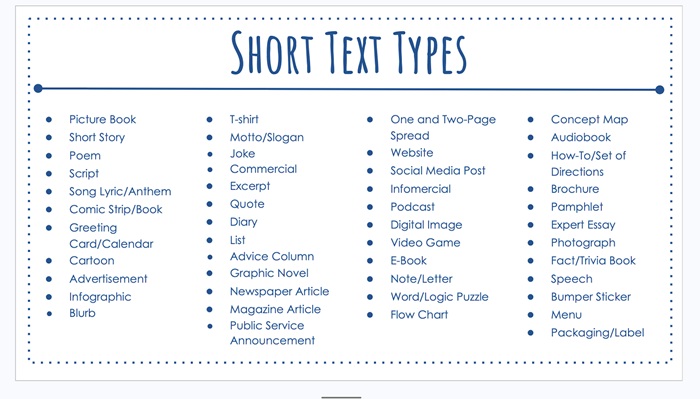
Here’s a capacity-building tip: Ask your librarian to curate some short text resources and make them available for students to enjoy during independent reading. Then, give students opportunities to share what they are reading with their peers.
2. Survey Students and Use the Data to Inform Planning
Knowing the topics and text types that students like and want to read takes the guesswork out of short text selection and gives us a leg up while planning. For example, if you know that a group of students loves animals and nonfiction books, you might share a two-page spread with them from Britannica’s Encyclopedia Infographica. If you are not sure what text types will get students jazzed up about reading, ask them! Here is a Short Text Survey to jumpstart this work. Using this data can inform our planning, giving us intel to rely on rather than our intuition or planning by trial-and-error. This is also helpful when helping students expand their reading diets by sharing and offering short texts that they might not otherwise select.
Here’s a capacity-building tip: Ask students for suggestions or give them opportunities to create other literacy surveys for the class. Use the intel you’ve collected to inform your planning.
3. Plan with an Instructional Focus Area
When you have a specific instructional goal, find a short text to teach it. Using an intriguing text type that can be read in one sitting is the key to making the most out of the (always) limited time in a classroom. For example, if students need to work on inferring, you can teach using one or more pages from Journey by Aaron Becker. There is no text to accompany these images and students will love creating a story to go along with the provocative pictures. Using an image as a short text really invites inference and paves the way for further inference with short stories and poems.
Here’s a capacity-building tip: Keep a bin or folder of engaging short texts and “shop” for one that will excite students. We return to this collection often, because short texts often serve more than one purpose. The same text can be revisited to teach multiple concepts.
Short texts are an engaging way to teach students a wide variety of skills and strategies. When we invite students to read about topics that interest them and we give them intriguing text types, they will read more and more. For additional ideas, check out our book, Shining a Light on Short Texts where you’ll find:
Our top 10 reasons for using short texts
Descriptions of multiple short text types (some may even be new to you!)
More than 24 ready-to-use planners with lessons for grades K-8
Multiple extension ideas for each lesson
Surveys, student note catchers, and a blank planner so that you can start to curate your own short text lessons and text sets
Are you ready to get started? There is a short text to match each and every instructional focus and goal – as well as every reader’s needs and interests. Short texts help your students go the extra mile by increasing reading volume while boosting their comprehension.
About the Authors

Julie Wright is an instructional coach, author, and consultant. With over 30 years in education, Julie’s practical and engaging approach to professional learning and classroom instruction has made her a trusted partner. She is the author of numerous educational books. Check out her website for more! www.juliewrightconsulting.com

Elizabeth Keim is a New York City-based educator with more than 30 years of experience. She is currently a Reading Recovery and AIS Reading teacher. She was a classroom and library teacher and has taught both undergraduate and graduate level courses.
Related book
Shining a Light on Short Texts
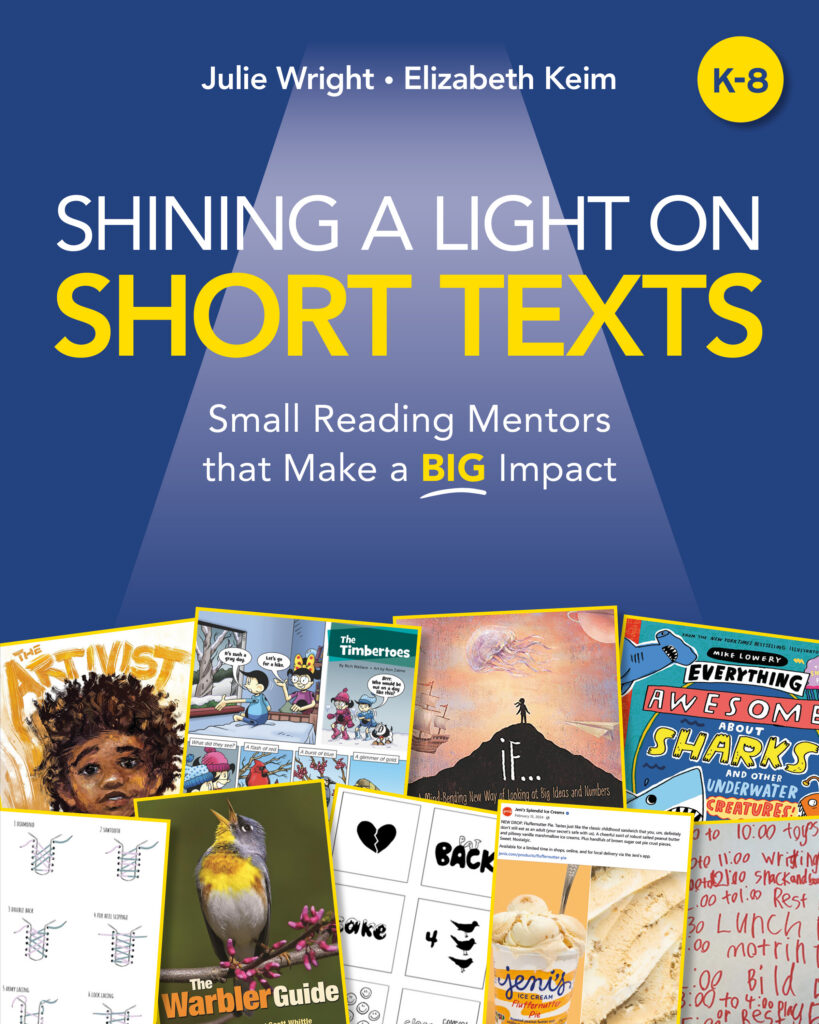
With a diverse collection of short texts to use as mentors alongside model planners embedded with ready-to-use lessons, this treasure trove of resources introduces readers to short texts while also establishing practices educators can easily replicate as they identify their own short text sources and create their own plans.
