What Is Phonological Awareness and How To Teach It
Reading time
Date posted

If you teach early learners, you’ve likely heard of the importance of phonological awareness. But what exactly are the skills embedded within that umbrella term? And what are some engaging and meaningful activities you can use for both whole-class and small-group phonological awareness instruction? Yvette Zgonc and Kimberly Zgonc answer those questions and more in the bestselling practical resource now in its second edition, Interventions for All: Phonological Awareness. Read on to find out more and download a free assessment from the book.
What is Phonological Awareness?
Phonological awareness (PA) is the understanding that our spoken language is made up of words and that our words are made up of individual units of sounds called phonemes. Children need to be able to manipulate these sounds to become fluent readers. PA skills include the concepts of spoken word, rhyme, syllables, phonemes, and phoneme manipulation.
Many children encounter difficulties with phonics instruction because they haven’t developed the prerequisite phonemic awareness skills. Children who begin school with little phonemic awareness will have trouble acquiring the alphabetic principle (recognizing that the written letters match up to the phonemes in words), which will, in turn, limit their ability to decode words (Blevins 2024). Phonemic awareness is a precursor to phonics. Phonics is the ability to recognize the letter-sound correspondence in words. It is critical to recognize that phonological awareness is an oral skill independent of print, whereas phonics is both a visual (i.e., print) and an oral (i.e., sound) skill. Phonics and PA are inextricably woven together.
How Much Time Should I Spend Teaching Phonological Awareness?
Researchers are not in exact agreement on how much time to spend daily or weekly on PA for whole-group instruction, but there is 100 percent agreement that it should be taught. Minutes a day vary from two to ten minutes a day (Kilpatrick 2023), five minutes a day (Blevins 2023), five to ten minutes a day (Moats 2020a), to thirty minutes a week (National Reading Panel 2000), among others. Of course, it is the quality of instruction and the responsiveness of the instruction to the individuals in the classroom that should be given greater consideration, rather than the time expended (Yopp and Yopp 2000).
Who Should Receive Lessons in Phonological Awareness?
All PreK through second-grade students should receive direct instruction in PA, but readers who are showing difficulties will need additional time. In Phonological Awareness, you’ll find activities written for whole-class instruction as well as a multitude of activities for those students needing more intensive intervention.
What Skills Are Included in Phonological Awareness?
There are sixteen skills within phonological awareness:
Concept of spoken word
Rhyme recognition
Rhyme completion
Rhyme production
Syllable blending
Syllable segmentation
Syllable deletion
Phoneme isolation of initial sound
Phoneme isolation of final sound
Phoneme blending-onset and rhyme
Phoneme blending-all phonemes
Phoneme segmentation
Phoneme deletion of initial sound
Phoneme deletion of final sound
Adding phonemes
Phoneme substitution of initial sound
Where Do I Start? Phonological Awareness in Action
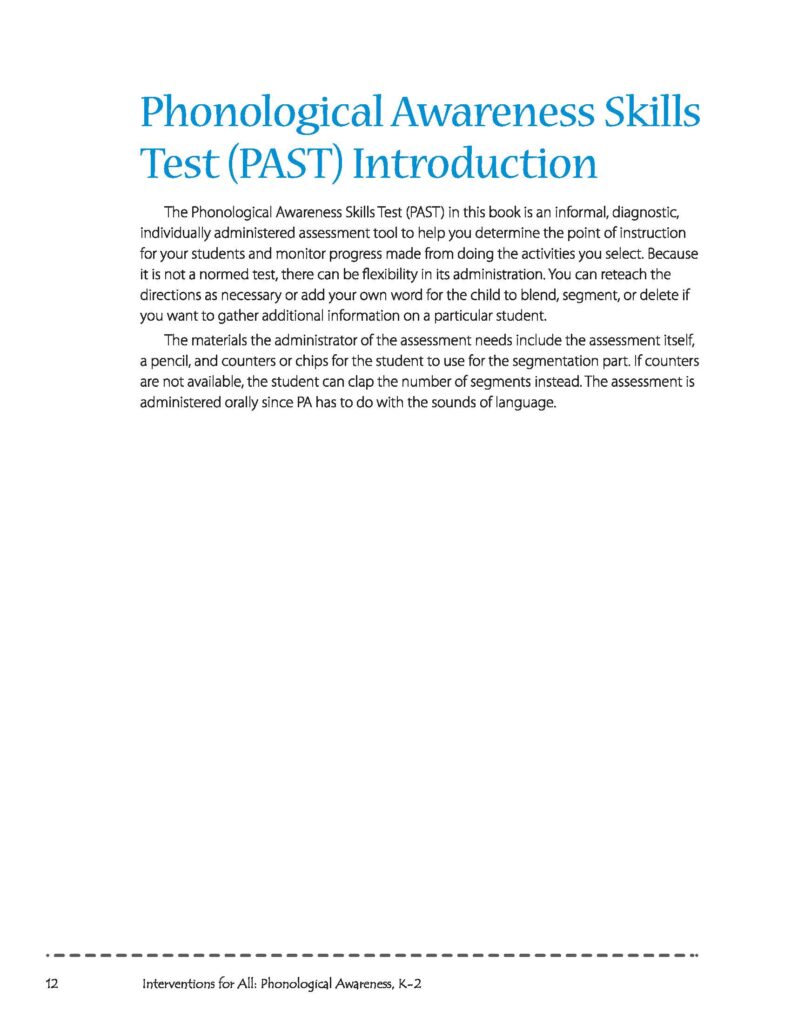
So, where should you begin? Included in the book (and downloadable below) is the Phonological Awareness Skills Test (PAST) which you can give to your class to determine which skills students need to work on. Of course, your ongoing informal assessment of students also provides valuable information. This assessment will support you in choosing from the 96 ready-to-go Tier 1, 2, and 3 lessons (and plethora of other related resources) in Phonological Awareness to try in your classroom!
Related book
Interventions for All: Phonological Awareness, K–2– Assessment Tools and Strategies
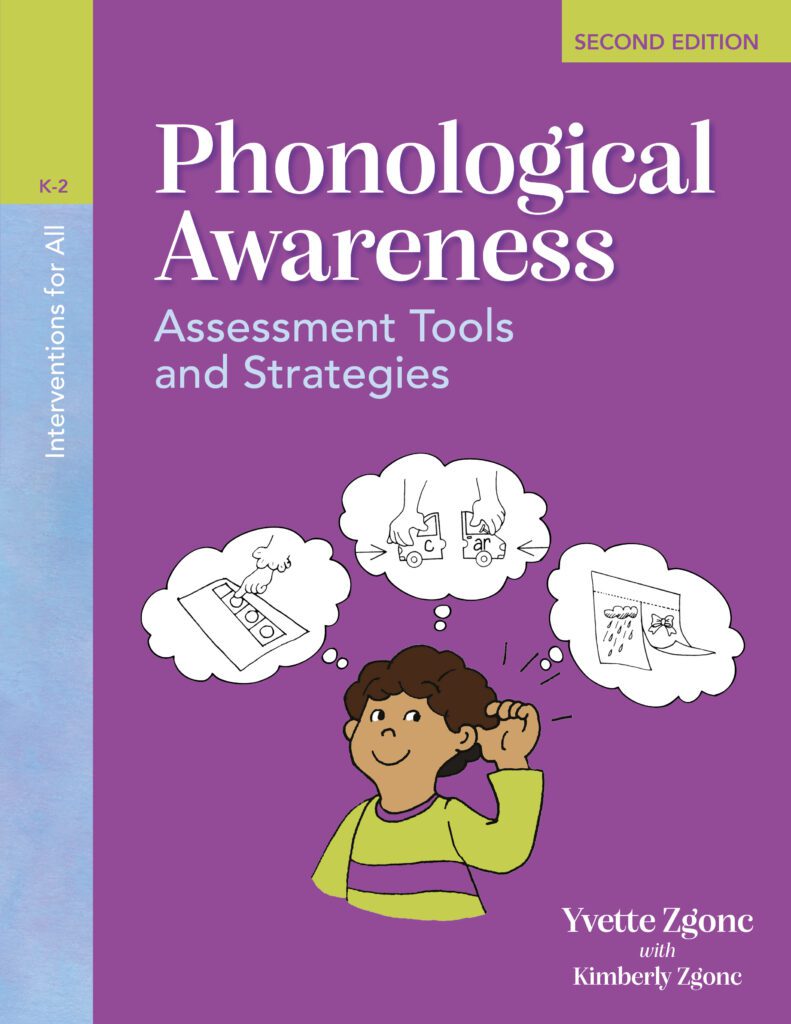
Featuring 96 engaging activities within a three-tiered RTI framework, this resource helps teachers differentiate instruction through research-based games, songs, and assessments. Whether they’re pretending to be superheroes, surgical assistants, baseball pitchers, or just lowly worms, get ready to see your students enjoy strengthening their phonological awareness skills!
Interventions for All: Phonological Awareness, K–2
If you’re looking for maximum learning that makes phonological awareness skills fun and impactful, Phonological Awareness will help you effectively engage your students and monitor their progress, while bringing you one step closer to the ultimate goal—success for all children.
Find Out More Here.
