Cutting Rhythms
Reading time
Date posted
Creative Film Editing
A blog post introducing the 3rd edition by the author of the book Karen Pearlman, ASE.

Cutting Rhythms is a book about what rhythm in film editing is, and how to develop your skills at shaping it. Over its three editions the book has had three titles.
The first edition was called Cutting Rhythms, Shaping the Film Edit. “Shaping” was the word I used to turn the reader’s attention to the processes and tools that this book focussed on in the first edition.
These processes and tools are still the focus of the book, but in the second edition I changed the title to Cutting Rhythms, Intuitive Film Editing. Using the word “intuitive” was, at the time, a way of bringing attention to the mind of the editor.
This third edition continues to do this, but it is doing something else, too. It is redefining what we call “intuition” as “expertise”. Developing reliable expertise in place of somewhat ineffable “intuition” will help us to meet the ever-evolving challenges of creativity in the edit suite.
So, to shift the focus once more, the third edition is called Cutting Rhythms, Creative Film Editing. Here I am aiming to bring it all together: the tools and processes; the implicit knowledge and expertise; and to focus these things on the creative work of shaping rhythm in film.
Adding the word “creative” into the title is a strategic move to put editors’ creativity front and centre, and to focus editors’ training on development of creative expertise. So, what do editors do that is expert and creative?
What Editors Do
Editors are responsible for piecing together the flow of three kinds of movement in a film. These are the movement of events, movement of emotions, and movement of image and sound. Editors shape these flows through a process of making decisions about which shot to use, where, and for how long, which is a deceptively simple description of the complex processes of responsive and generative creative work that three-time Academy Award– winning editor Thelma Schoonmaker calls “the art of decision making.”[i]
Editors often describe their decision-making processes with variations on the word “intuitive,”[ii] which is a catch-all word for knowledge and ability that has been acquired through implicit learning and experience.[iii] However, “intuitive” does not mean there is not a wealth of expertise at work; it simply means that much of the expertise is embodied, embedded or enactive and therefore functioning at a pre-conscious level.
A short list of the kinds of expertise editors refer to under the umbrella term “intuitive” includes the following:
Interpersonal expertise in recognizing and responding to a director’s partially or inexactly articulated “desires”[iv];
Expertise in design of appropriate story structures for the context of a particular production[v];
Expertise in noticing and responding to potentials for emotional nuance in (fictional or actual) character’s behaviour and exchanges[vi] ;
Expertise in sensing or perceiving potential visual and aural rhythms and dynamics inherent in uncut material[vii];
Memory expertise that supports the “search and retrieval” of specific material from among many hours of possible options[viii];
Expertise of “kinaesthetic imagination” deployed when considering which options to select and try out from the material[ix];
Choreographic expertise that supports the shaping of movement from moment to moment, and overall, into satisfactory phrasing of events, emotions, and visual/aural experiences[x];
Finally, what might be called “technical” expertise, which refers to editors’ embedded mastery of tools of editing—be they the scissors and glue of the 1920s, the motorized flatbeds of the 1970s, or the digital editing software widely in use since the late 1990s.
Unfortunately for editors, the only instance of this expertise that is visible in action is their “technical” expertise of operating the gear. The rest of it takes place in a speedy, unspoken domain of distributed cognition wherein ideas are generated and realized through the entanglement of brains, bodies, filmed material, and context.
That only the interaction with tools is visible leads to what cultural theorist Raymond Williams would call a division along “class lines” of editors’ expertise, whereby editing is associated with “operation of the technology itself” and this creates an opportunity for “doubt whether such workers were truly part of cultural production.”[xi]
Indeed, in America, anyone involved in the direct handling of tools on a filmmaking set is referred to as a “technician,” a “class” that leads to exclusion from authorship claims in both the cultural and the legal domain.[xii] The question arises: how can we peel away the myth of invisibility and see the editor’s professional dexterity with tools and hands as itself a part of the thinking, the ideation, the creative work required to shape a film’s rhythms?
This book is all about answering that question. Starting with what I mean by “creative” and what I mean by “rhythm”.
Creative first.
In broadly accepted definitions, creative means something that is new and/or valuable. It also applies to a person who makes something new and/or valuable and similarly to a process that generates something new and/or valuable.[xiii]
The ‘newness’ isn’t absolute, it is relative to other aspects of culture. New might be in relation to all of history, or to this moment in time, it could simply be new to the person, or new to the project they are working on. In this sense editing is necessarily creative – an editor is transforming the material from its raw form into something new – a film. Similarly, each individual edit is creative. It creates a new juxtaposition. Whether that juxtaposition supports telling the story, creates a metaphor, generates a feeling, pleases the eye, or does anything else for the project is a question of value. Since value is determined contextually, this book will not attempt to define it further. Instead, I will focus on creative process – the ways we work to shape structure and rhythm, the kinds of expertise editors draw on when doing this work, some things we do and ways we do them to generate value for our projects.
The key “value”, as in the “new and valuable” thing this book is focussed on is rhythm. However, asking “what is rhythm in film editing?” is actually asking three questions.
The first of these is, “what is rhythm made of?” This is the part of the question that I look at in Chapter 3. My answer is that the materials for making rhythm are time, energy, and movement, and this chapter provides some understanding of what each of these things is for an editor and how we experience and shape them.
The second question is “how is rhythm shaped?” Here I am asking about how an editor works on rhythm, or how the raw materials of rhythm are shaped into a coherent and compelling form. In Chapter 4, I focus on three tools or operations that that editors draw on: timing, pacing, and trajectory phrasing. Even though all of these are present simultaneously in the editor’s expert work, each of these can be broken down into more refined operations. Analyzing how an editor works on rhythm is useful because the words for the editor’s tools—timing, pacing, and trajectory phrasing—are also words for what audiences ultimately experience. We shape these things for an optimal audience experience.
The third part of asking “what is rhythm” is actually asking: “what is its purpose?” Rhythm is a felt experience, and Chapter 5 describes its purpose as being: to modulate feeling and attention into “cycles of tension and release”; and to “synchronize” an audience to the movement of images and sounds, emotions and events in a film.
So, what is rhythm in film editing?
Rhythm in film editing is time, energy, and movement shaped by timing, pacing and trajectory phrasing, for the purpose of creating cycles of tension and release.
Cutting Rhythms will unpack that definition of what rhythm is, and how we develop expertise in creating rhythms in the following chapters:
Chapter 1 – From Intuition to Expertise
Cutting Rhythms begins, in Chapter 1, by asking about intuition. What kinds of expert thinking and practice are editors referring to when they say the processes of creating rhythm are “intuitive”? If we understand intuition as expertise, can the capacity to cut “intuitively” be developed? Cutting Rhythms proposes that it can. It draws on diverse sources of knowledge about intuition, including science, philosophy, education, film theory, and even dance theory to define ways of strengthening, supporting, and refining rhythmic expertise. Chapter 1 describes the editor’s intuition about rhythm as something developed from mindful awareness of the rhythms of the world and the rhythms of one’s own body. These are the sources of the editor’s embodied expertise and implicit intelligence about rhythm, and they are also the triggers that activate the editor’s creativity in cutting rhythms.
Chapter 2 – Watching, Sorting, Remembering, Selecting & Composing
This chapter breaks down editing into a series of expert actions. It focusses on how editors do these things differently than other creative people on the film crew. Having set up, in Chapter 1, that editor’s expert intuitions can be developed, this chapter looks at how editors develop their capacities to watch, sort, remember, select and compose, and how we deploy this expertise to create and define a film’s rhythms.[xiv]
Chapter 3 – Editor as Choreographer: Time, Energy & Movement builds on the ideas in Chapters 1 & 2 about editors’ creative thinking-in-action and embodied expertise in shaping movement. It puts forward the notion that editing is a form of choreography, because, like choreographers, what editors do is manipulate the composition of moving images and sounds to shape a meaningful flow. This chapter starts by shifting the discussion of rhythm from music to movement; then looks at the underlying materials from which rhythms are made: time, energy and movement. Finally, it looks at some of the ways in which choreographers and dancers work with movement and finds that these provide some quite useful ideas about craft for shaping a film’s rhythms.
The tools for cutting rhythms are discussed in Chapter 4: Timing, Pacing & Trajectory Phrasing. This chapter breaks down and defines “timing” and “pacing.” It also introduces “trajectory phrasing,” a term devised to describe some of the key operations an editor performs that are not precisely covered by timing or pacing. “Trajectory phrasing” is what we are doing when choosing different takes of a performance to join together, to create the impression of a single flow of energy and intention. It is a useful way of thinking about some key editing decisions.
Chapter 5: Tension, Release & Synchronization looks at the purposes for which movement in film is shaped into rhythms. It describes the effect of rhythmic cycles of tension and release on the viewer’s mind and body, and the effect of synchronization that a film’s rhythm can have on the rhythms of a viewer.
These five chapters, roughly the first half of the book, fully unpack my definition of rhythm in film editing as “time, movement, and energy shaped by timing, pacing, and trajectory phrasing for the purpose of creating cycles of tension and release”.
With that definition in hand, Cutting Rhythms then applies its ideas about intuition, choreographic approaches, and the tools and purposes of rhythm to the different types of rhythm that editors encounter.
Chapter 6: Good Editing is Not Invisible, kicks off the second half of the book with a discussion of the kinds of rhythm that editors are shaping. It suggests that understanding them as the different priorities influencing decisions at different times can help an editor work their way through the complex processes of wrangling all event rhythms, emotional rhythms, and visual/aural rhythms, separately and together.
This chapter includes the judging criteria devised for the Australian Screen Editors Guild Awards. These criteria helped the guild to set up their awards by pointing out the things that can be seen in good editing: movement of images and sounds, movement of emotions, movement of events, and the “style” editors create and sustain in shaping movement.
Chapter 7: Physical Rhythm focusses on the movement of images and sounds – the kinds of scenes and events that are conveyed primarily through physical movement. Abstract or poetic films rely heavily on this kind of rhythm, as do dance scenes, fight scenes, chase scene, and more.
Chapter 8: Emotional Rhythm looks at the ways that editors can use time, energy and movement of performers and social actors to shape the dynamics of emotions as they move across faces and bodies. This chapter describes some techniques of acting and interacting that express feeling as they occur in conversations and performances.
Chapter 9: Event Rhythm focusses on the work editors do in shaping structure and describes the kinds of patterns we create, over the course of a whole film, as rhythmic designs. It ends with two case studies that bring together physical, emotional and event rhythms into coherent and compelling experiences for audiences.
Finally, Cutting Rhythms offers three chapters that address particular editing issues and opportunities.
Chapter 10: Style looks at the kinds of decisions an editor makes about thematic montage, continuity cutting, collision, and linkage when establishing and sustaining a style.
Chapter 11: Collaboration & the Vulcan Mind Meld looks at one of the editor’s most complex issues and opportunities—collaboration—and playfully describes the process of collaborating with directors as a “Vulcan Mind Meld.”
The book ends with Chapter 12: Editing Thinking & Onscreen Drafting. This final chapter describes the capacities, skills, and strategies of the previous chapters as “editing thinking”, a process comparable to design thinking or studio thinking. It then makes a challenge to standard production processes to engage the editor’s thinking into the filmmaking process much sooner, for much better results, through a process of “onscreen drafting”.
Cutting Rhythms is written for editors and filmmakers who are learning their craft and more experienced practitioners who find their work benefits from discussion of their craft. Knowledge about rhythm helps students and editors to shape rhythms and maximize their material’s rhythmic potential. It is also relevant to the screen studies scholar who is interested in the connection of theoretical ideas to practical methods and outcomes. Its purpose is to stimulate ways of thinking and talking about rhythm in film and to understand and deepen rhythmic creativity.
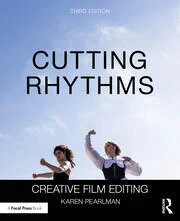
Cutting Rhythms: Creative Film Editing
There are many books on the technical aspects of film and video editing. Much rarer are books on how editors think and make creative decisions. Filled with timeless principles and thought-provoking examples from a variety of international films, the third edition of Karen Pearlman’s Cutting Rhythms offers an in-depth study of the film editor’s rhythmic creativity and expertise, the processes and tools editors use to shape rhythms, and how rhythm works to engage audiences in film. Cutting Rhythms is written for editors, filmmakers, and students who are learning their craft, and more experienced practitioners who enjoy engaging with ideas about creative process.
End Notes:
[i] Thelma Schoonmaker as quoted in Anderson, H. “The Woman behind Martin Scorsese,” Elle,
November 2011, 5, https://www.elle.com/culture/movies-tv/a12336/thelma
-schoonmaker/.
[ii] See Oldham, G. (1992) First Cut: Conversations with Film Editors. Berkeley:
University of California Press; Oldham, G. (2012). First Cut 2: More Conversations with Film Editors. Berkeley: University of California Press; McGrath, D. (2001). Editing and Post-production Screencraft. Crans-Pres-Céligny: Roto- vision.
[iii] Atkinson, T. & Claxton, G. (2000). The Intuitive Practitioner: On the Value of Not Always Knowing What One Is Doing. Buckingham: Open University Press.
[iv] Polan, D. (2001) “Auteur Desire,” Screening the Past. (12) 1–9, http://www.screeningthepast.com/2014/12/auteur-desire/.
[v] For more on story structures see Chapter 9: Event Rhythm.
[vi] Emotional nuances and ways of spotting and shaping them are the subject of Chapter 8: Emotional Rhythm.
[vii] Chapter 7: Physical Rhythm focusses on scenes or passages that are driven primarily by the visual and aural movement in material.
[viii] See: Kirsh, D. & Maglio, P. (1994). On Distinguishing Epistemic from Pragmatic Action. Cognitive Science 18, no. 4: 513–549.
[ix] See Reynolds, D. (2007) Rhythmic Subjects, Uses of Energy in the Dances of Mary Wigman, Martha Graham, and Merce Cunningham. Hampshire: Dance Books. And/or Pearlman, K. (2017) Editing and Cognition beyond Continuity. Projections: The Journal for Movies and Mind. 11, no. 2: 67–86
[x] Chapter 3: Editor as Choreographer, Time, Energy & Movement introduces the editor’s skills and strategies that might be called ‘choreographic’.
[xi] Raymond Williams, R. (1981). Culture. London: Fontana. 115
[xii] Ibid.
[xiii] See: Boden, M. (2018). Creativity and Biology. in Gaut, B., & Kieran, M. (Eds.). Creativity and Philosophy. Routledge. https://doi-org.simsrad.net.ocs.mq.edu.au/10.4324/9781351199797
[xiv] This framework of ‘watching, sorting, remembering selecting and composing’ was first developed for the groundbreaking edited volume Cognitive Theory and Documentary Film, edited by Catalin Brylla and Mette Kramer. Excerpts from that chapter are reproduced by kind permission of the publisher, Palgrave MacMIllan. For the full chapter, see: Pearlman, K. (2018). Documentary Editing and Distributed Cognition. In: Brylla, C., Kramer, M. (eds) Cognitive Theory and Documentary Film. Palgrave Macmillan, Cham. https://doi.org/10.1007/978-3-319-90332-3_17
