From “One Right Way” to Many: How to Plan for Student Thinking
Reading time
Date posted
By Mona Iehl

What if there wasn’t just one “right way” to solve a math problem?
I grew up thinking there was only one right way to solve, and if you didn’t get it you just weren’t a math person. I was taught the steps of the “right way”, but not to understand the math behind the steps. So, when I got stuck I had no way to reason through the problem solving.
As a teacher in my own classroom, I started to see students approach problems in different ways, using their own ideas to reason, create, and explain their thinking. I realized math could be a space for students to build understanding through experience, not just follow steps. That’s the kind of classroom Word Problem Workshop helps us create, and the one I want us to build together.
What if there were lots of ways to solve a problem?
Think about your everyday life—there’s no one right way to load the dishwasher, get your kids out the door in the morning, or make a cup of coffee.
That’s how we treat word problems in Word Problem Workshop
Students are encouraged to use what they know and what they can do. Their thinking might come from life experiences or prior school math, but the focus is always on reasoning, problem solving, and trying.
Take for example a partitive division problem:
12 pencils are shared equally among 3 students. How many pencils does each student get?
A primary-grade student might not set up a division equation or recite a math fact automatically—but they are absolutely capable of solving this problem. Here are a few ways they might approach it:
Fair Sharing with Concrete Manipulatives
A student might grab 12 Unifix cubes to represent the pencils, then place three sticky notes on their desk, one for each student. They might begin passing out the cubes one at a time onto each sticky note. Once they’ve shared all 12, they’ll count to see that each student received 4 pencils.
Fair Sharing with Visual Representation
The student draws 3 kids and 12 pencils, then draws lines or circles to show the pencils being handed out one at a time. As they distribute the pencils evenly, they see each child ends up with 4. They may even write a total under each person to show the count.
Repeated Subtraction
The student will start with 12 and subtract 3 (giving one of these three to each student). They may represent it like this: 12 – 3 = 9 and continue subtracting 3 until they reach zero. It would look like this:
12 – 3 = 9
9 – 3 = 6
6 – 3= 3
3 – 3= 0
Then they would revisit the equations to see that they subtracted 3 four times, meaning the students got 4 pencils.
These are just a few examples of possible strategies. But there are even more ways students might approach this problem, some you might predict, and some that will surprise you.
That’s where the Forecasting Guide comes in.
A Forecasting Guide helps you anticipate the multiple ways students might solve a problem—so you can plan more intentionally. When you know what to look for, you can listen more closely, highlight key strategies during the Share, and design your Discussion to deepen understanding across your class.
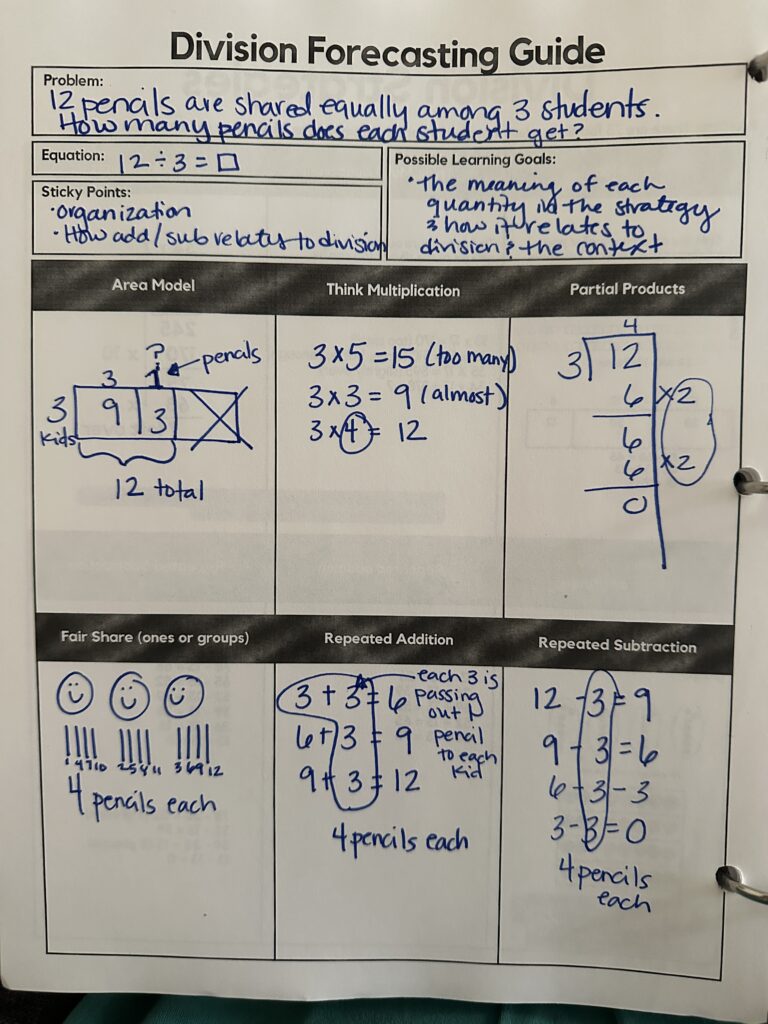
The Forecasting Guide is a way for teachers to plan for the various ways students might solve the problem.
Every problem has multiple solution pathways. The one a student chooses is based on their current understanding, and it gives us a window into their thinking. Before we jump in and tell them what to do, we give them time to try. We observe. We learn what they understand, what strategies they’re developing, and what math they can do, even if they don’t yet have the words to explain it.
When students are given the chance to make sense of a problem and use what they know, they build confidence. They also begin to understand what math really is: a way to solve problems, ask questions, and make sense of the world.
That’s the goal of Word Problem Workshop.
We plan for Grapple time that honors student thinking and we follow it with intentional sharing and discussion that builds understanding. With tools like the Forecasting Guide, we don’t just respond to student thinking, we prepare for it, value it, and use it to move every student forward.
About the Author

Mona Iehl is an elementary educator who transformed her approach to teaching math by embracing student-centered methods that foster curiosity and engagement. She now coaches educators nationwide to create inclusive math classrooms where all students develop deep, lasting problem-solving skills.
You can connect with Mona online @HelloMonaMath or www.monamath.com
Word Problem Workshop: 5 Steps to Creating a Classroom of Problem Solvers
Word Problem Workshop is a daily routine for building confident problem solvers and transforming your classroom into a student-centered environment for mathematical exploration and learning. With this step-by-step guide you’ll learn practical strategies and facilitator moves that help teachers let students’ thinking take the lead.
